Skip to content

Apps

Custom software when the business needs a tool that does not exist.

Build a focused internal app, a customer-facing product, or a multi-tenant system you can license or franchise. Goldstone also licenses software it has already built, where using the existing engine is faster and less expensive than starting over.


Custom software is a different kind of engagement from a website build, and it’s the hardest thing to pre-price honestly — no two apps want the same things. So the configurator below is a starting point rather than a quote: it gets you to a real number and a real range before you talk to anyone, and we confirm the specifics once we understand the job.

What’s above it is the proof we can build it.

Two buying paths run through this page. A custom app is written for you from scratch and can be assigned to you as the agreement defines. Licensed Goldstone software is a platform we already built and already run — faster and materially cheaper than commissioning the same thing again, licensed to you rather than sold. Not every app is licensed software, and which one you are is settled before the build. How ownership and licensing work, and Goldstone Intelligence explains the shared platform a licensed build stands on.


Shipped software

Applications we've built and run.

Every one of these is deployed and in use. Most run behind a login because they carry real deals and real operations.

Minor Subdivide Analyzer

Deal underwriting

Deal underwriting

Minor Subdivide Analyzer

Underwrites a minor-subdivide deal end to end — split scenarios against cost and exit assumptions — and turns the result into an investor-ready deck. It's the tool we run our own acquisitions through.

Next.js 14 TypeScript Tailwind CSS Chart.js Supabase
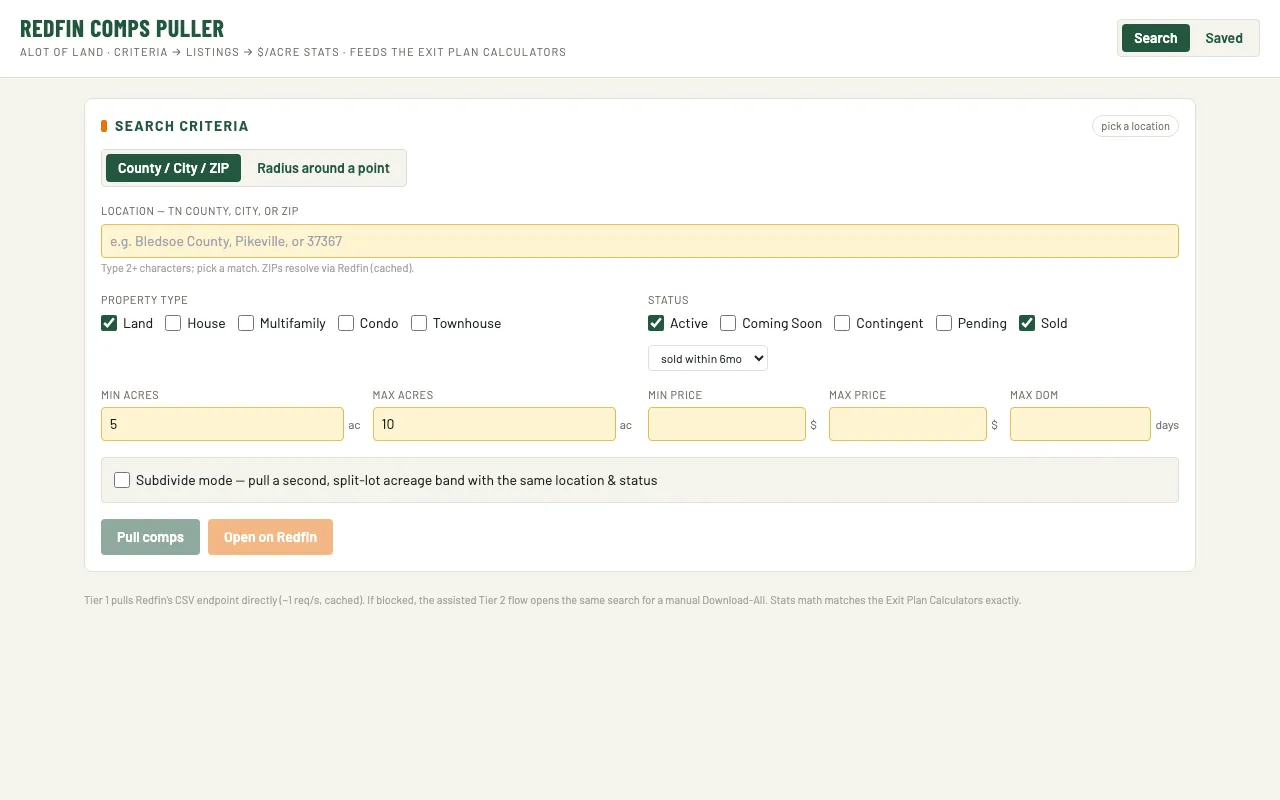
The Redfin Comps Puller search criteria screen

Comps & valuation

Redfin Comps Puller

Pulls vacant-land comparable sales, computes $/acre statistics, and exports comps that feed straight into the Exit Plan Calculators. Search by county, city, ZIP, or a radius around a map pin.

Node.js Vite Tailwind CSS

MFDA — Multifamily Deal Analyzer

Multifamily underwriting

Multifamily underwriting

MFDA — Multifamily Deal Analyzer

Takes the land underwriting model into multifamily: active and sold 2–20 unit properties across Arizona and Tennessee, running through a shared listing adapter so new data sources plug in without a rewrite.

React Supabase Tailwind CSS

Land Scout

Parcel research

Parcel research

Land Scout

Finds and qualifies parcels, works out highest-and-best use, and turns a rough sketch into a plan — the research step before a deal is worth underwriting at all.

Next.js TypeScript Supabase

Time Audit

Operations

Operations

Time Audit

Logs activities against value tiers — $10K, $1K, $10–99, and $0 per hour — so you can see where the week actually went instead of where you assume it went. Built because running several businesses made the question urgent.

React 19 Vite Supabase Recharts

Build it

Configure your build, see the number.

Start from the base and add what the business actually needs. The total and the timeline update as you go — no form to fill in first.

Custom software is the hardest thing to pre-price honestly, and anyone who tells you otherwise hasn't built much of it. Treat every number here as a starting point, not a quote. Two apps that sound identical in a sentence can differ by a factor of three once you know what they actually have to do. What this gets you is a realistic range and a shared vocabulary before we talk — not a figure we'd hold you to, and not one we'd hold ourselves to either.

Included base

Focused custom app

One core workflow built properly — the screens it needs, a real data model behind it, hosted and responsive. The starting point for software that does one job well.

$15,000

Add what you need

  • Additional screen / workflow view

    Each additional distinct view beyond the core workflow — a list, a detail page, a settings panel.

    +$1,000

    per screen

    0 screens
  • User accounts / roles / permissionsHas running costs

    Sign-in, roles, and per-user data separation, so people only see what's theirs.

    Identity providers typically charge above a free monthly active user threshold.

    +$3,000

  • Admin dashboard / reporting

    A back office to see what's happening — records, activity, and numbers you can act on.

    +$3,500

  • External integrationHas running costs

    Each external system the app reads from or writes to — a CRM, a calendar, an accounting tool, a data source.

    Some APIs charge for access or meter requests. Which ones, and how much, depends entirely on the services involved.

    +$1,500

    per integration

    0 integrations
  • File / document storageHas running costs

    Users upload documents, photos, or exports, and the app stores and serves them properly.

    Storage and bandwidth bill on usage. Small for documents, meaningful for video or imagery at volume.

    +$1,500

  • Payments / subscriptionsHas running costs

    Take one-time payments or run recurring billing, with the plumbing to handle failures and cancellations.

    The payment processor takes a percentage of every transaction.

    +$3,500

  • AI featuresContact for scopeHas running costs

    Anything where the app has to interpret rather than just store — summarizing, extracting, classifying, drafting. Custom quote, since it depends entirely on the job.

    Billed per request by the model provider, so it scales with how much the feature is actually used.

    What this takes to set up · Adds 2–4 weeks
    • A defined job with a checkable right answer
    • Sample data to test against before it goes live
    • A review period where output is checked before users rely on it

    $5,000+

  • Multi-tenant architectureContact for scope

    Run the same app for multiple clients under their own branding and their own separated data. Custom quote — this reshapes the whole data model, so it's much cheaper decided up front than retrofitted.

    What this takes to set up · Adds 3–5 weeks
    • Decided before the build starts, not after — retrofitting tenancy is close to a rewrite
    • A branding model: how much each tenant can change
    • Per-tenant data separation verified before launch

    $10,000+

  • Rush deliveryFaster delivery

    Moves you to the front of the queue and compresses the timeline.

    +25%

  • Franchise / White-label LayerContact for scope

    The operating layer above multi-tenancy: territory and location administration, franchisee controls, per-location branding and domains, cross-organization reporting, and royalty or billing hooks. Multi-tenant architecture is what makes this possible; it is not the same thing, and it is priced separately.

    $15,000+

Your apps estimate

$15,000

Estimated — your final quote is confirmed after we talk.

  • Focused custom app$15,000

Estimated delivery

4–8 weeks

Focused build

Pricing more than one service? Add each and send them together.

Or send just this one

Most serious custom applications land between $20,000 and $60,000. Ongoing service is optional and currently starts at $500/month.

The full system

Need the workflow behind the site too?

Add CRM, follow-up, reporting, a portal, AI workflows, or custom software without starting another project from scratch.

Build the Full System

Past the configurator

Some work doesn't fit in a form.

The configurator handles builds we can scope from a list of modules. Above that, the work stops being a bigger version of the same thing — it's a different engagement, and it starts with figuring out what's actually being built rather than picking parts.

Systems built to be resold

Software a business sells on to franchisees or members — multi-tenant from the start, with the accounts, permissions, and billing that implies.

Multi-location and multi-site

One system, many locations or brands, sharing a spine but not a database row. Different problem from one site done well.

A full presence, not a website

When the site is one piece of a larger push and the photography, video, and campaign have to hold together with it.

Priced per engagement, after we understand the work — typically starting around $25,000, and scoped in writing before anything begins.

One thing we'll say early rather than late: a build is limited by the assets going into it. If the photography and video aren't there yet, we'll tell you that before the design, not after — it's the difference between a site that looks expensive and one that looks like it wanted to.

Start a conversation

After launch

Build once. Keep improving every month.

Every build can end at handover — your data, content and domain are yours either way. Most don't end there, because software that nobody tends stops working long before it looks broken.

Care

$500/mo

Everything stays up, patched, backed up, and current.

A build that's finished and needs to stay healthy.

  • Hosting, domain, and SSL managed for you
  • Security patches and dependency updates
  • Daily backups, and a tested way to restore them
  • Uptime monitoring — we find out before your customers do
  • Small content changes, up to an hour a month
  • Email support, next business day

Software that isn’t maintained doesn’t stay still, it degrades. You can handle this yourself — we’ll hand over everything and show you how. Most people would rather not.

Month to month. Cancel any time.

Managed

Most common

$1,500/mo

We keep building. You get hours every month and someone who knows the system.

A business that keeps changing, and a system that has to change with it.

  • Everything in Care
  • Five hours of build time every month — new pages, features, fixes, whatever it is
  • A monthly call to decide what those hours go to
  • Priority response, same business day
  • Google Business Profile kept current
  • Integrations monitored, and repaired when a third party changes something
  • Quarterly report on what shipped and what it did

Most work doesn’t end at launch. Under Care those changes become quotes; here they’re just the next thing we do.

Hours don’t roll over. A plan that banks them turns into a debt we’re both managing instead of work that gets done.

Month to month. Cancel any time.

Growth Intelligence

$3,000/mo

The build stays current and the site actively works on getting found.

A business where one won job pays for the year.

  • Everything in Managed
  • One improvement shipped every week — a guide, an answer, schema, internal links
  • Written to be extractable by AI engines as well as ranked by Google — structured so an answer can be lifted cleanly, with no promise it will be
  • Monthly check of whether ChatGPT, Perplexity, and Google AI Overviews actually name you
  • Review requests drafted for you to send after each job
  • Local rank tracked from the places your customers actually search
  • A monthly number for what that traffic would have cost to buy

Plenty of people now ask an assistant who to call and take the answer. Getting named there is a different job from ranking, and neither is something anyone can promise you.

One genuinely useful improvement a week, rather than a batch of thin ones. We favour deliberate publishing over mass-generated pages because usefulness and clarity are what hold up over time — but no publishing cadence guarantees a ranking or a citation.

We don’t buy links, automate reviews, or spin up pages with the town name swapped. Those tactics trade durable authority for short-term volume, and they carry real search-quality risk.

Month to month. Cancel any time.
Operating Partner

from$5,000/mo

We function as your product and systems team, without you hiring one.

A business where software is now part of how the money is made.

  • Everything in Growth Intelligence
  • A larger development allocation every month, scoped to what the business needs
  • Workflow improvements as the operation changes, not once a quarter
  • AI and automation monitored, with failures caught before they cost you
  • New dashboards and reporting when a question needs answering
  • Integrations built and maintained as your tool stack moves
  • A product roadmap kept current with where the business is going
  • Priority response
  • A systems audit every quarter

Scoped per engagement. Included hours and response times are defined in the agreement.

Plans start after launch and are quoted with the build, so the monthly number is never a surprise later. Third-party costs — hosting that scales, message fees, model usage — are billed through at cost plus a small markup and itemized.

Goldstone-owned software may also carry a separate platform license where applicable. See how build, licence and service are priced .

Questions people ask first.

Why is app pricing an estimate instead of a fixed quote?

Because a fixed price on an unknown scope is either padded or a fight later, and usually both. The modules are priced from work we have actually done, so the number is grounded — but custom software is where estimates go wrong, because the hard part is almost always something nobody mentioned in the first conversation. Two apps described identically in a sentence can differ threefold once you know what they really have to do. What we do instead is scope the first phase properly, price that firmly, and build it. By the end we both understand the shape of the thing and the rest can be quoted with real confidence. If someone gives you a firm number for a custom app before asking hard questions, they have either built your exact app before or they are guessing.

How do I choose a custom software development company?

Ask three things before anything else. Will the person who scopes it still be involved when it is built, or does it pass to whoever is free that week? What exactly do you own at the end, and what is licensed to you? And will they tell you when software is not the answer? Published pricing is a fourth signal. A firm that will not put a number in public rarely puts one in writing early either.

What if the scope changes halfway through?

Scope usually does change partway through a software build, and that is not a failure — you learn things once real software is in front of real users. Goldstone quotes changes as they come up rather than absorbing them silently and slowing down, or springing an invoice at the end. You will always know what a change costs before we build it, and you can always say no.

Do I own the code?

Yes, for a custom build. You get the repository, the data, and the right to take all of it to another developer. That's different from our licensed apps, which stay ours and are licensed to you — a distinction worth knowing before you commit rather than after. If you want a custom build that starts from one of our existing tools, we'll tell you plainly which parts you'd own and which stay licensed.

Can you take over an app someone else started?

Sometimes, and we will look before answering. An unfinished codebase can be cheaper to finish or more expensive than starting over, and which one it is depends on decisions made before we arrived. We will read it and give you an honest answer, including if that answer is that your money is better spent rebuilding.

What does it cost to run once it is built?

Hosting starts around $250/month for a typical app, covering the server, the database, and monitoring. On top of that, some features bill on usage: AI features per request, file storage by volume, payment processing as a percentage, and some third-party APIs by call. The configurator flags every module that carries running costs, and we quote the realistic monthly figure before you commit — not after launch.