Skip to content

Portfolio

Sites that are actually running businesses.

Every entry below is live and in production. Each one lists the full breakdown — what the front-end does, what the systems behind it do, and how leads are captured and followed up.

Live Since 2024

alot.land

A land investing business — acquiring, subdividing, and selling rural and residential land. Not a client project: it's the company Goldstone runs, and the reason most of the land tooling exists.

alot.land is the proof. It's a production site running real acquisition traffic, backed by the same stack Goldstone sells — and the deal-analysis apps in the investor bundle were all built to serve it first.

Astro Tailwind CSS Netlify Decap CMS
Visit alot.land

Goldstone didn’t build alot.land for a client. We built it for ourselves, and it’s been running acquisitions ever since.

That matters more than a portfolio piece normally would. The tooling in the investor package — due diligence, parcel research, subdivide analysis — exists because this business needed it. Every one of those apps was used on a real deal before it was ever offered to anyone else.

Front-end

  • Seller-facing acquisition funnel built to convert cold land owners
  • Property listing pages with photo galleries and location context
  • Offer request and property submission forms
  • Buyer list capture for disposition
  • Static-rendered and mobile-first — fast on rural cell service
  • Self-editable content, listings, and pages through a git-backed admin

Back-end & systems

  • Git-based CMS — every content change is a versioned, revertible commit
  • Form submissions captured and routed without a third-party form service
  • Automated image optimization at build time
  • Multiple sites served from a single monorepo
  • Continuous deploy on push, with atomic rollbacks

CRM & lead handling

  • Lead capture wired from every form on the site into one pipeline
  • Automated first-response so inbound seller leads don't sit cold
  • Follow-up sequences that continue until the lead replies
  • Source tracking to attribute leads back to campaign and page

roverct.com

roverct.com

In build

In progress

Rover CT

Mobile 3D CT scanning that comes to the veterinary practice. Gold-standard imaging has historically lived only at emergency hospitals and radiology referral clinics — Rover brings a Claris V scanner to the parking lot, so a practice can offer advanced CT without buying or maintaining a machine.

Goldstone is building the connected operating system around the business: the public site that acquires practices, the portal those practices work in, scheduling and service-area logic, records, invoicing and payment, notes on every practice, urgent-request handling, and the operator's daily dashboard.

Next.js TypeScript Supabase Stripe Netlify

The operating problem

Advanced CT imaging has always lived where the machine lives. A veterinary practice that wants a scan refers the case out to an emergency hospital or a radiology clinic, loses the client for that visit, and waits on someone else’s schedule for the result.

RoverCT changes where the machine is. A Claris V scanner arrives in the practice’s parking lot for a half day or a full day, and the practice offers advanced imaging without buying, housing, staffing or maintaining a machine.

That is a good idea with an operational problem attached. The business only works if the right practices can find it, understand an unfamiliar service, register, book a day that a vehicle can actually reach, get records back, and be invoiced correctly — repeatedly, without the founder holding it together by memory and phone.

Why a website alone would not solve it

The obvious first purchase is a website. It would not have worked.

Every hard part of RoverCT happens after someone decides they are interested: which counties can be served on which day, whether a practice is registered, what happened on the last visit, what the practice owes, and which requests are urgent enough to break the schedule. A brochure site with a contact form hands all of that back to a person with a phone.

The build is therefore a business operating system with a public site attached, rather than a website with software bolted beside it.

What Goldstone is building

One system covering acquisition through payment: the public site, practice registration, the portal practices work in, request-based scheduling, county service-area logic, practice records and notes, invoicing, a payment workflow, urgent-request routing, and the operator dashboard the day is run from.

The database was designed for multiple organizations from the first commit — not because RoverCT has franchisees today, but because retrofitting isolation into a single-operator system later is a rebuild rather than a feature.

Architecture decisions that keep the options open

Three choices were made early, each cheap at the time and expensive to add afterward.

Multi-organization from the first commit. Every tenant-scoped table carries an organization, and isolation is enforced in the database rather than by remembering to filter a query. That is what makes a second operator a configuration change instead of a migration.

Never a diagnostic viewer. The system receives, archives, routes and tracks studies and reports. It does not display images for interpretation, because a validated diagnostic viewer is a regulated product and radiologists already read on their own. Knowing what not to build is most of what kept this project deliverable.

The scheduling model follows the vehicle. Availability is decided by which counties a vehicle can reach on a given day, rather than by a generic calendar, because a schedule that looks full and crosses the region twice loses a day’s work.

What this demonstrates for other mobile businesses

A mobile veterinary CT service is not a roofing company, a restoration contractor or a mobile grooming franchise, and the workflows are genuinely different. What transfers is the shape of the problem: a service that travels, capacity limited by vehicles and geography, customers who need to book and be billed, records that must outlive whoever answered the phone, and an owner who becomes the bottleneck the moment the second vehicle arrives.

Goldstone architected around that model once. The same foundation — identity, organizations, permissions, scheduling, records, billing, reporting — is what the next mobile operating system starts from.
Front-end

  • Explains a service most practices have never booked, in the order they ask about it
  • Step-by-step process walkthrough from scheduling through results
  • The economics made explicit — who charges the pet owner, and what the practice keeps
  • Practice-facing scheduling inquiry for half-day and full-day visits
  • Mobile-first, since vets read this between appointments

Back-end & systems

  • Practice portal with its own sign-in, records and invoices
  • Operator dashboard for the working day
  • Request-based scheduling with county-level service-area rules
  • Invoicing and a Stripe payment workflow
  • Urgent requests routed separately from ordinary bookings
  • Multi-organization architecture with database-enforced isolation

CRM & lead handling

  • Practice records with notes that outlive whoever took the call
  • Registration and account state per practice
  • History attached to the practice rather than to an inbox

Live Since 2026

My Private Nurse

Private duty nursing for Scottsdale and Phoenix — post-surgical recovery and in-home care from a board-certified RN with seventeen years of experience.

A portfolio site for an independent nurse — credentials, services, and service area in one place, fully editable by the owner as her practice changes.

Astro Tailwind CSS Netlify
Visit myprivatenurse.health

Front-end

  • Credential-forward homepage built around board certification and experience
  • Service pages covering post-surgical recovery and in-home care
  • Local search targeting for Scottsdale and Phoenix
  • Mobile-first — most inquiries arrive from a phone

Back-end & systems

  • Editable copy and services without a developer
  • Continuous deploys from git

Live Since 2026

Beyond Belief

Theatrical release site for the feature film Beyond Belief — trailer, ticket sales, group bookings, and church partner resources, all live for an August 28th opening.

A release site is a launch-window problem, not a brochure. Everything funnels to tickets, and it has to hold up under a traffic spike on opening weekend.

Astro Tailwind CSS Netlify
Visit beyondbelief.movie

Front-end

  • Trailer-led homepage with the release date carried throughout
  • Ticket purchase and group booking paths kept one click away
  • Dedicated resources section for church and partner bookings
  • Merchandise storefront

Back-end & systems

  • Editable release dates, links, and copy without a developer
  • Built to absorb a launch-window traffic spike on static hosting

Live Since 2026

BuilDeFi Documentation

The full documentation and whitepaper platform for BuilDeFi — a fair-launch DeFi protocol. Covers token creation, the liquidity engine, fee allocation, and the gamification system across a structured, searchable set of docs.

A whitepaper nobody reads is worth nothing. This replaced a static document with a documentation site — searchable, cross-linked, and structured so a reader lands directly on the section that answers their question.

Astro Starlight Tailwind CSS Netlify
Visit docs.buildefi.win

Front-end

  • Full-text search across every page
  • Structured navigation by audience — builders, traders, liquidity providers
  • Deep-linkable sections so a question resolves in one click
  • Mobile-readable technical content, including tables and formulas

Back-end & systems

  • Markdown-based content, versioned in git
  • Continuous deploys — a docs change ships in a minute
  • Built to extend as the protocol adds surfaces

Software

Applications we've built and run.

Same breakdown as the sites above — what each one does, what's behind it, and where it runs. Most sit behind a login because they carry real deals and real operations.

Minor Subdivide Analyzer

Minor Subdivide Analyzer

Private tool

Deal underwriting Private tool

Minor Subdivide Analyzer

Underwrites a minor-subdivide deal end to end — split scenarios against cost and exit assumptions — and turns the result into an investor-ready deck. It's the tool we run our own acquisitions through.

  • Full financial model with per-scenario split, cost, and exit math
  • Deal flags that surface the assumptions doing the heavy lifting
  • Charted output built for showing an investor, not just an analyst
  • Unit-tested calculations locked to the original underwriting model
Next.js 14 TypeScript Tailwind CSS Chart.js Supabase

comps.alot.land
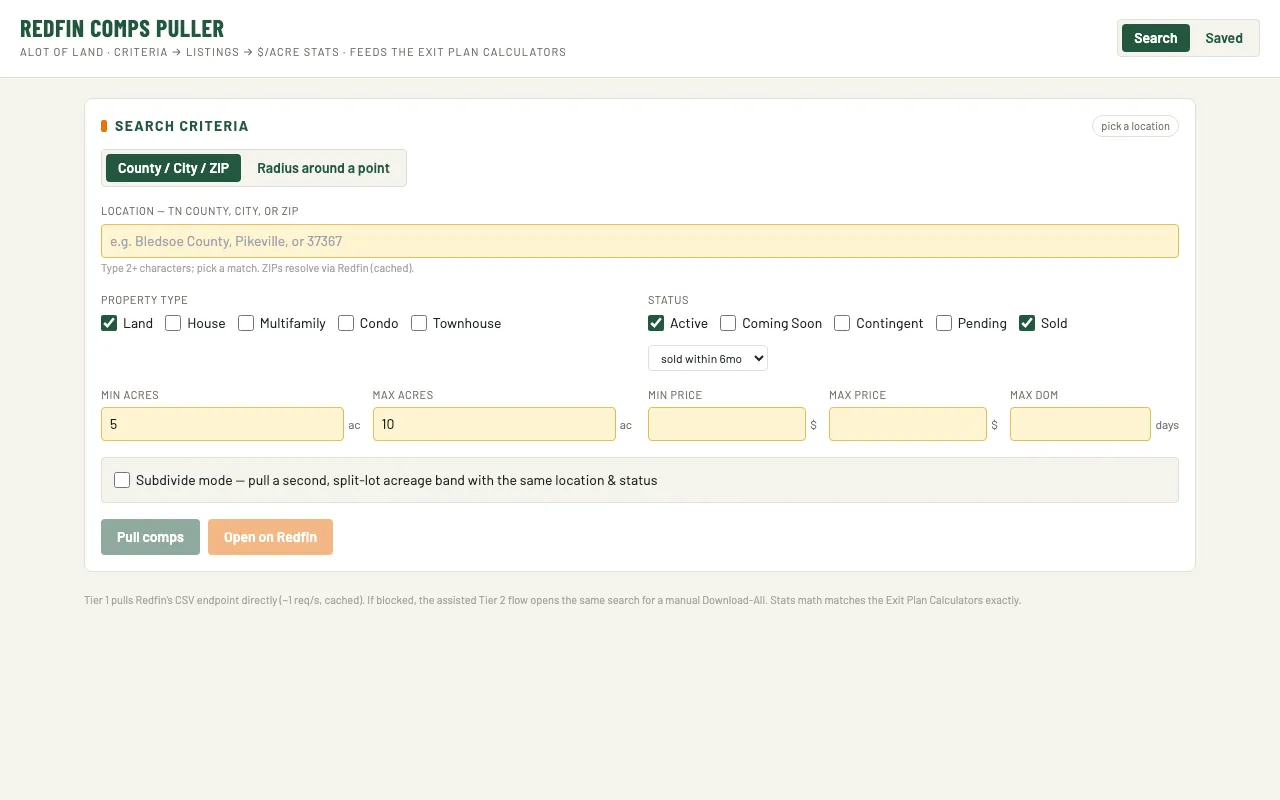
The Redfin Comps Puller search criteria screen
Comps & valuation

Redfin Comps Puller

Pulls vacant-land comparable sales, computes $/acre statistics, and exports comps that feed straight into the Exit Plan Calculators. Search by county, city, ZIP, or a radius around a map pin.

  • $/acre statistics computed across a chosen acreage band
  • Location search by county, city, ZIP, or radius around a point
  • Exports comps JSON directly into the Minor Subdivide Analyzer
  • Falls back to an assisted pull rather than failing silently when blocked
Node.js Vite Tailwind CSS
Open comps.alot.land

MFDA — Multifamily Deal Analyzer

MFDA — Multifamily Deal Analyzer

Private tool

Multifamily underwriting Private tool

MFDA — Multifamily Deal Analyzer

Takes the land underwriting model into multifamily: active and sold 2–20 unit properties across Arizona and Tennessee, running through a shared listing adapter so new data sources plug in without a rewrite.

  • Active and sold multifamily comparables across AZ and TN
  • Shared listing-source adapter so new data providers slot in
  • Magic-link auth with per-user data isolation
React Supabase Tailwind CSS

Land Scout

Land Scout

Private tool

Parcel research Private tool

Land Scout

Finds and qualifies parcels, works out highest-and-best use, and turns a rough sketch into a plan — the research step before a deal is worth underwriting at all.

  • Parcel search and qualification without stitching together county sites
  • Highest-and-best-use analysis on a candidate parcel
  • Sketch-to-plan generation for split concepts
Next.js TypeScript Supabase

Time Audit

Time Audit

Private tool

Operations Private tool

Time Audit

Logs activities against value tiers — $10K, $1K, $10–99, and $0 per hour — so you can see where the week actually went instead of where you assume it went. Built because running several businesses made the question urgent.

  • Every activity logged against a dollar-per-hour value tier
  • Weekly breakdown of where the time actually went
  • Reflection prompts that turn the data into a decision
  • History synced across devices, private to the signed-in user
React 19 Vite Supabase Recharts

More sites launching

Additional client sites are in build and will be added here as they go live.

Have a workflow that needs its own system?

Every build here started as an operating problem rather than a design brief. Tell us yours and we'll tell you what should be built — or that it shouldn't be.